
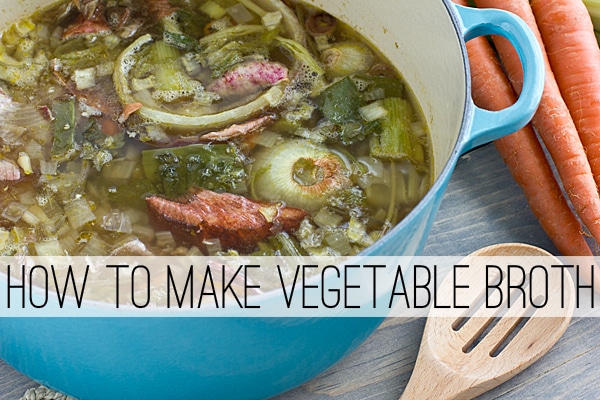
Making vegetable broth is one of those things that's really easy to do, but I bet most of us don't do it. Or, at least, don't do it often.
I use vegetable broth in a lot of my recipes, but I'll be honest, I often use store-bought broth. But I shouldn't because making your own vegetable broth is so, so easy. And you know what else? It tastes so much better too.
Unlike meat-based broths, there's no skimming off fat or any of that ickiness. You don't need to keep the pot on the stove for hours either. But it does require a little bit of advance planning. It also requires these three things:
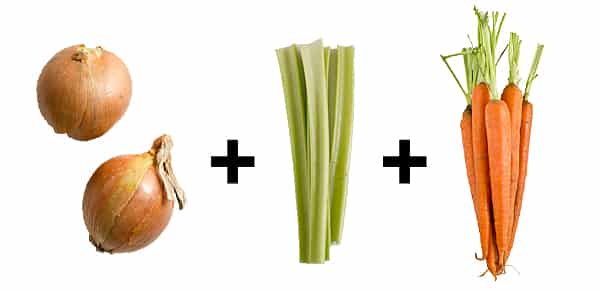
Onions (or a member of the onion family--leeks or shallots work too), celery, and carrots. That's your starting point, but from there, you can tailor your broth to what you're going to be using it for.
And of course a pot! A large stock pot like this one will work best, or a Dutch oven is a great choice as well.
Add sprigs of thyme and parsley to make a cooking liquid for rice and other grains. If you're going to be using the broth as a base for an Asian-inspired soup (like this Thai Red Curry Soup), try adding fresh ginger and lemongrass.
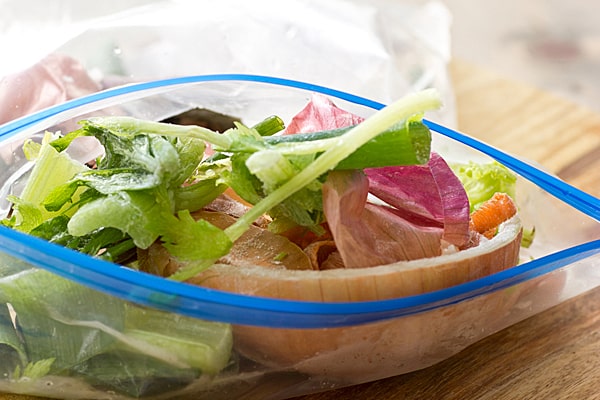
Now, back to that thing I said about advance planning! You can buy whatever you want for your broth, chop it all up, and put it in your stockpot. But I'm cheap and it kills my soul a little to think about throwing away all those perfectly good veggies.
It's bad enough I have to throw away the onions, celery, and carrots!
So instead of buying what I need, I collect scraps in a freezer bag and when I have a few cups worth, I use them to make broth. Here's what I used in this particular batch:
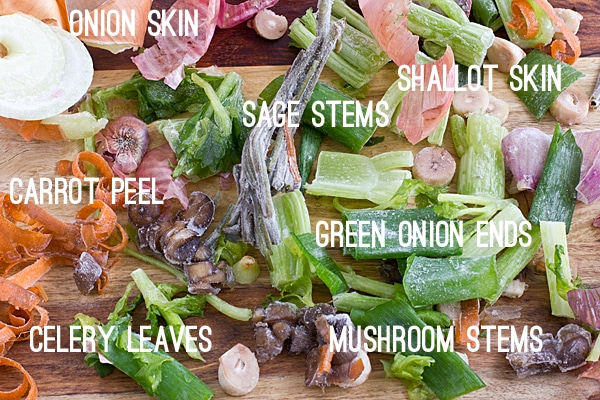
But really, you can use so many different things. You do want to stay away from cruciferous veggies--no cabbage, no broccoli, no cauliflower, and for the love of all things holy, no brussels sprouts--because they can leave bitter flavors in your broth.
Make sure everything you use is clean too--you don't want to make dirt soup!
And remember, there's a difference between things you don't want to eat vs. things you shouldn't eat. Clean carrot peel is fine in a broth or stock; a moldy carrot is not.
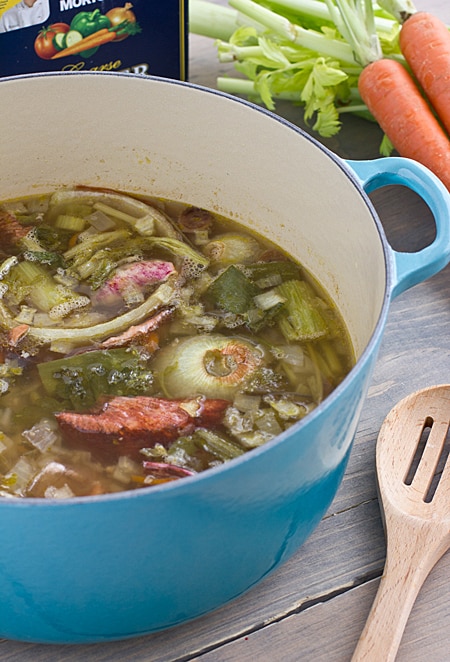
Oh, and speaking of stock! Have you ever wondered the difference between vegetable broth and stock? Broth is seasoned, while stock is not.
So this recipe can be used for both vegetable broth or stock. To make stock, skip adding salt and pepper at the end.
And if you want to make your own broth, but aren't keen on the idea of using your veggie scraps, go check out this vegetable stock recipe too.
📖 Recipe
Equipment
Ingredients
- 1 tablespoon olive oil
- 5 cloves garlic, minced
- 2 onions, large, chopped
- 3 ribs celery, chopped
- 3 carrots, chopped
- 8 cups water
- frozen vegetable scraps, 2-3 cups is a good amount
- 2 bay leaves
- parsley, a few sprigs
- thyme, a few sprigs
- salt and pepper, to taste, omit if you are making stock
Instructions
- Heat the olive oil in a large Dutch oven or stockpot over medium heat.
- Add the garlic, onions, celery, and carrots. Cook until softened, about 5 minutes, stirring often.
- Add the water, frozen vegetable scraps, bay leaves, parsley, and thyme. Reduce heat to low and simmer, partially covered, for 45 minutes.
- Pour the broth through a fine mesh strainer into a large heat-proof bowl or pot; discard solids.
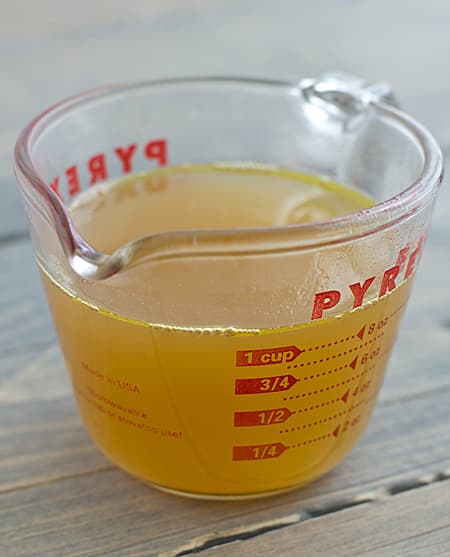
- Once the broth has cooled, transfer it to airtight plastic containers or freezer bags and store it in the freezer. (I usually freeze it in 2-cup portions so I don't have to thaw all the broth every time I use it.)
Nutrition (estimated per serving)
This post was originally published on January 8, 2013.

Derek says
Delicious and easy
Mariya says
This is really a great recipe. I will make this at the next chance i get.
Nataly says
That recipe looks so yummy! I'll have to try that one. Thanks for sharing.
Adriana says
It is delicious indeed!
Joshua Howard says
Thank you for sharing the recipe! I have a question. Can I make it without olive oil?
Elaine says
I made the broth this morning . then I found this post and guess what I put eight cups of kale in it I pretty sure I should throw it out and start over ! Any advice
Gbob says
WTF!?! -- FROZEN vegetable scraps? You can't use fresh vegetable scraps? They have to be frozen first? And no fresh vegetables of any sort? And no dried herbs?
Cody says
Lmao... My goodness, Karen. I want to start by saying ai love your dramatic use of "WTF?!" and subsequent ineptitude to understand that the frozen veggie scraps are from previously prepared meals. People like you really provide for some great internet entertainment.
Nora says
Cody, that was the best response I have ever read!!
Stacie Roberts says
So I don't need to use cut up vegetables just the scrap, but make sure that they are frozen..
Just Susan says
So the idea is, when you are cooking... like BEFORE you even approach cooking this recipe, save the veggie scraps. like mushroom stems, celery and onion tops and bottoms, carrot and potato peels, extra parsley or rosemary. Freeze them use them LATER to make your stock or broth.
Yvonne says
Hi so what I did was as use fresh vegetable scraps that I had frozen till I had enough to make the broth. That way you have less waste and get more usage out of your veggies! I hope this helps!
Shelly says
The article literally says this: "So instead of buying what I need, I collect scraps in a freezer bag and when I have a few cups worth, I use them to make broth." Pretty easy to understand. Maybe go back and re-read a few times first before commenting.
Marquita Herald says
Excellent response. I admit I was stunned by the snarky-like reactions when the intention seemed clear. Anyway, I'm looking forward to trying this, and since I just made a batch of carrot raisin salad, I have a starter bag of carrot peels to stick in the freezer and build on.
Krystal says
Just say you didn’t read the article.
Gina says
Why are some people so clueless!
It’s such common sense really!?
Take the time to READ the recipe!
Thelma says
Hi do you get flavor or color from onion skins? ive never thought of using them in stock.
Thanks
tomohisa watanabe says
"The outer skins of onion and garlic provide an excellent source of vitamins A, C, E, and numerous antioxidants. The skins of onions are also a rich source of flavonoids, particularly quercetin, a potent antioxidant and anti-inflammatory."
https://www.google.com/search?q=onion+skin+vitamin&rlz=1C1KDEC_enUS837US837&oq=onion+skins+vit&aqs=chrome.1.69i57j0i22i30.9769j0j7&sourceid=chrome&ie=UTF-8
CYNTHIA D WESSON says
In making the homemade food for my 2 dachshunds, I am left with a huge amount (close to 24 oz of broth) from green beans, carrots, green peas & chopped broccoli. While I do want to freeze some broth, I am wondering if I could can it as well. Have you ever canned your broth? Any suggestions will be greatly appreciated, thank you...Cynthia W.
Brian says
I’ve been saving my vegetable scraps for years. Some go to compost, but the rest go into a ziplock in the freezer, when it gets full, I make broth. Normally I add some dry herbs or clip off some thyme or rosemary from the garden. After broth cools pour into ziplock and freeze flat.
Maria says
Simple and Easy. Thanks for sharing.
rl says
just wondering if you could puree the broth, instead of straining? You would get a thicker broth and more fibre?
Nicole @ Oh My Veggies says
You definitely can do it. But the texture would be much thicker than broth. Whether it would taste good or not - that would really depend on what type of vegetable scraps you used! If you experiment with this, I would love to hear how it goes!
Ning says
Thank you for providing this amazing recipe.
mel says
I've made this over and over. Love it every time. So easy!
Kk says
Hello, after making the broth or stock, do you add any water to it or use it as is when making soup? Thanks for the recipe and information as well.
Katie says
This was such a helpful recipe! Thanks from my freezer full of vegetable broth and I 🙂 I added some extra carrots, water, frozen veggies and spices. and cooked for a bit longer and it turned out great!
jack says
Some of these people are as dumb as rocks, if they would bother to read they wold not have to ask such stupid questions
stephanie says
Thanks for the recipe! I used it in a lentil loaf and it turned out great. My family loved it for Christmas dinner! I usually bought from the store but I wanted to reduce waste so homemade was definitely more green.
Angel says
Thank you for posting this versatile easy recipe! I appreciate your answers to comments as well. Helpful and entertaining. I garden, I cook, I reuse when I can, and I compost.
Alana says
Right!
Double Whammy Granny says
This is an awesome recipe that I have used to make so many other recipes that call for vegetable broth or chicken broth better!
To further my minimal waste mission I save my empty spice jars which nicely hold 1 cup of liquid. I fill them with the broth & freeze them. Whenever a recipe calls for broth, I just pull a couple jars from my freezer!
Cheenu says
Great one!
Easy to make, wholesome and flavourful, enjoyed it!
Thanks much!!
Daina says
I have been using this recipe since I quit buying the vegetables broth from the store. I mainly use it for the base of homemade soup or recipes require liquids, water or broth. I feel good about doing something good for my own health. Thank you!
Kat says
I am always looking for new recipes and avoid waste. I love making all my broths at home from scratch, knowing exactly what is in them is important to me. This recipe is easy & I used my instant pot rather than stove. once done, strained thru cheesecloth and freeze. Thanks for a good recipe!
Diandra hinds says
It is so delicious and easy to make